The Language Under Hatibagan
THIS IS A WORK OF FICTION
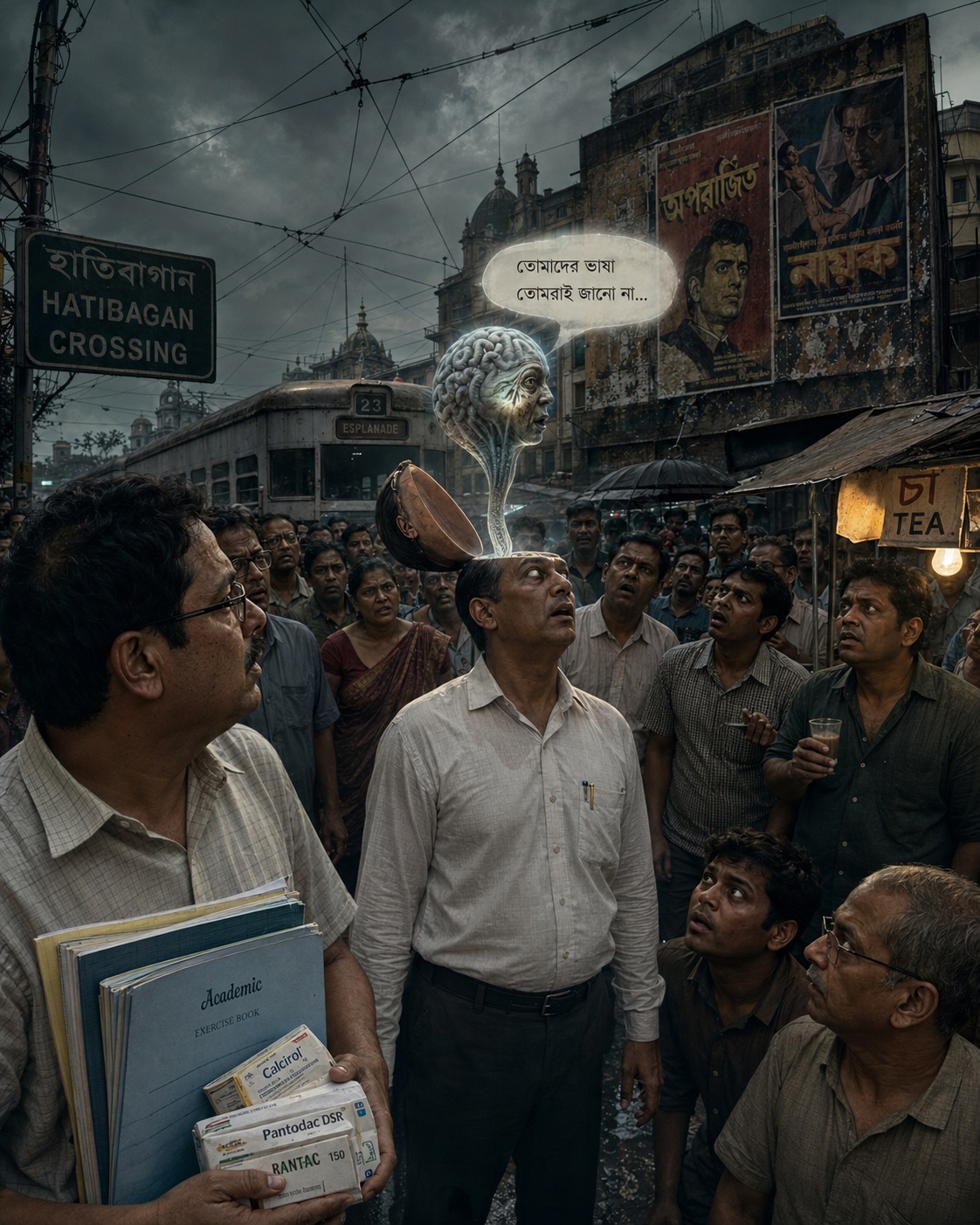
The man’s head opened at the Hatibagan crossing just as the tram bell rang twice, which later seemed to everyone either an omen or an insult.
It was a Saturday afternoon of sweating wires, bad tempers, and fish wrapped in old examination papers. Rain had threatened since morning but refused to fall, like a relative who phones every week saying he will visit and then mercifully does not. Autos coughed blue smoke. A hawker selling plastic combs had spread his kingdom over half the pavement. A goat nosed a heap of wilted coriander. The old cinema wall still wore a torn poster of a hero aiming a pistol at a villain who had long ago vanished from public life but, like many villains, remained in excellent circulation.
Mrinmoy was carrying four exercise books, a packet of blood-pressure tablets for his mother, and a humiliation he had been polishing for six months.
He had once taught physics in a private coaching center near Shyambazar. Not a grand profession, but a clean one. Boys came to him with expensive calculators and faces made anxious by their parents. Girls came with neater handwriting and better questions. Mrinmoy liked the moment when Ohm’s law stopped being a formula and became a small municipal truth: pressure here, resistance there, current everywhere, life behaving more or less badly but predictably.
Then the coaching center closed.
The owner said enrollment had dropped. Parents wanted “integrated packages,” air-conditioning, test analytics, success guarantees, the whole circus. A teacher with chalk on his fingers and a cracked shoe was now a minor artisan in a factory of panic. Mrinmoy was forty-three, unmarried, living with his mother in a damp two-room flat in Belgachia, where the ceiling had developed brown islands that resembled maps of countries nobody wished to invade.
He had come to Hatibagan to ask an old student’s father about a tutoring job. The father had not recognized him at first. Then he had remembered too much.
“Still teaching?” he had asked.
“Trying,” Mrinmoy said.
The man had smiled with professional pity. “These days, sir, children need exposure.”
Mrinmoy had almost said, “To what? Radiation?” But he needed work, so he swallowed it.
Now he stood by a tea stall, counting his remaining money, when the man in the white shirt began to tremble.
He was ordinary in the way Calcutta makes men ordinary by sanding them down: office trousers, cheap belt, one black shoe slightly whiter with dust, hair dyed with that purplish confidence seen among clerks before weddings. He stood near the tram tracks, staring at nothing. His mouth worked. At first Mrinmoy thought heatstroke. Then the man’s scalp made a neat sound.
Not a crack. Not a tear.
A polite little click.
The parting began above his left eyebrow and ran backward through the dyed hair as if an invisible hand were opening a tin trunk. The crowd did what crowds do best. It came closer.
“Arrey, ki holo?”
“Don’t touch him!”
“Some fit.”
“Move, move, let air come.”
The man remained upright. The two halves of his head separated by the width of two fingers. There was no spray, no cinema nonsense. Only a smell like wet iron and old library paste. From within rose a grey, folded thing, glistening softly in the heat, not bloody exactly, but too alive in the way mushrooms are too alive after rain.
Then it spoke.
“Do not be afraid,” it said in clean, educated Bengali-accented English. “We have been rehearsing for some time.”
A silence fell over the crossing so complete that even the tram seemed embarrassed.
The tea seller, who had survived three evictions, one marriage, and jaundice, recovered first. “Who is we?”
The thing turned without eyes. Its folds shifted like slow lips.
“All who were taught to remain inside.”
That was when the man in the white shirt collapsed.
Mrinmoy moved before thinking. Perhaps because he had once known how to respond to a lab accident; perhaps because decency, like tuberculosis, sometimes remains dormant until conditions favor it. He pushed through the crowd, knelt, and felt for a pulse. Weak but present. The opened head steamed faintly. The brain-thing had withdrawn halfway, sitting within the skull like a passenger unsure whether this was its stop.
“Someone call an ambulance,” Mrinmoy said.
Everyone looked at everyone else with the ancient Calcutta skill of delegating responsibility by facial expression.
A girl in a yellow kurti said, “I called. They said location?”
“Hatibagan crossing!”
“They asked which side.”
“The side where a man’s head is open!”
This was accepted as a reasonable landmark.
The man’s lips moved.
Mrinmoy bent close.
“Don’t let them take me to Nilratan,” the man whispered.
“Why?”
The man’s eyes filled with a terror too precise to be shock. “They will recognize my voice.”
Then the brain spoke again, not from the open skull now, but from the man’s mouth.
“Mrinmoy Bhattacharya. Son of Malati. Failed teacher. You still dream of the pond behind the old house.”
Mrinmoy dropped the man’s wrist.
The crowd looked at him.
He had not told anyone about the pond in thirty years.
It had been in Konnagar, behind his uncle’s house, green and scummed over, with a broken cement ghat where children were told not to play. He had been eleven when his cousin Tublu slipped. Mrinmoy had seen the white of Tublu’s shirt under the water. He had run for help instead of jumping in. Adults later said he had done right; he was a child, he could have drowned too. Their comfort had entered him like a splinter and stayed.
The ambulance came after twenty-two minutes, which in Calcutta counts as punctuality with spiritual ambition.
A young constable arrived before it and began shouting at everyone not to take photographs, though several people had already taken enough photographs to restart civilization. Mrinmoy tried to step back, but the man’s hand caught his wrist.
“My name is Prabir Sen,” he said, though his voice was no longer only his. “Tell my daughter I did not sell the room.”
Then he fainted.
The hospital smelled of phenyl, boiled rice, and human waiting. Mrinmoy sat on a broken plastic chair outside emergency because the constable, having discovered no superior officer wished to inherit a man with a speaking brain, decided Mrinmoy was “witness” and therefore portable paperwork.
Prabir Sen had been taken behind a curtain. Twice doctors entered. Once a nurse came out with her face sharpened by fear and said, “Who brought him?”
Mrinmoy raised his hand.
“Relative?”
“No.”
She gave him the look hospitals reserve for men who are neither useful nor paying. “Then why are you here?”
The answer seemed too large for the corridor.
A woman arrived at seven. She was perhaps thirty, thin, hair tied in a careless knot, wearing office clothes gone limp from rain that had finally started outside. She introduced herself as Raka Sen, Prabir’s daughter. Her eyes moved quickly, accounting for threat, cost, shame.
“You saw it?” she asked.
“Yes.”
“Did he say anything?”
Mrinmoy hesitated. “He asked me to tell you he did not sell the room.”
Raka’s mouth tightened.
“Which room?”
She looked away. “He says many things.”
“Not like this.”
“No,” she said. “Not like this.”
The constable, bored into cruelty, said, “Madam, your father was speaking foreign-type things from inside head.”
Raka closed her eyes.
It was not disbelief on her face. It was recognition.
Mrinmoy noticed then the ordinary clue that would trouble him later: a thin strip of red cloth tied around Raka’s wrist, not religious, not decorative, but faded and knotted with care. Prabir had worn the same strip around his right ankle when they lifted him into the ambulance.
A doctor came out near eight and asked for the family.
Raka stood.
“Patient is stable,” he said, which in hospitals can mean anything from “nearly fine” to “we have not yet lost the body.” “There is no active bleeding. CT machine is down. We are shifting him for imaging elsewhere.”
“His head opened,” Raka said quietly.
The doctor adjusted his spectacles. “There is a cranial abnormality.”
“It spoke.”
The doctor looked at Mrinmoy, annoyed that witnesses existed. “People under seizure speak. Families panic.”
“It knew my name,” Mrinmoy said.
The doctor’s expression changed only slightly. Enough.
Raka said, “May I see him?”
“Two minutes.”
Mrinmoy should have left then. His mother would be waiting for tablets. The rice cooker at home had a temperament. The damp ceiling would not admire itself. Yet he stayed because Prabir Sen had named the pond, and because the creature had said: all who were taught to remain inside.
Raka emerged ten minutes later carrying a folded hospital bedsheet under one arm.
“Come,” she said.
“Where?”
“Not here.”
“That sounds like a kidnapping done on a budget.”
For the first time, she almost smiled. “You are funny for a man who looks permanently unpaid.”
“I am permanently unpaid.”
“Then come. We have a common enemy.”
Outside, rain had turned the street into black glass. They took a taxi whose driver objected to the destination, then to the rain, then to the existence of both passengers. Raka gave an address near Beadon Street, an old house divided into rented portions, its entrance squeezed between a closed bookshop and a shop selling imitation jewelry for brides who had learned early to compromise.
On the way, she spoke without looking at him.
“My father was a projectionist at Minerva Talkies. Before it shut. Later he guarded the building. We lived in one room behind the old screen.”
“Cinema hall?”
“Half cinema, half ruin, half litigation. In Calcutta mathematics, property always has three halves.”
“What room was he talking about?”
“The sound room. Behind the balcony. He kept it locked.”
“Why?”
“He said voices lived there.”
The taxi splashed past College Street. Bookstalls crouched under tarpaulin. Students argued under one umbrella, their future bright enough to be ruined properly. Mrinmoy saw, with the pain of a man who had once believed education could rescue people, how the city sold books by the kilo and respect by the square foot. Everyone wanted learning, but nobody wanted teachers unless they came laminated with certainty.
Raka said, “He was not mad.”
“I didn’t say he was.”
“You thought it politely.”
“I am Bengali. I think everything politely first.”
This time she did smile, and the smile vanished quickly, as if ashamed of taking up space.
The old cinema smelled of dust, pigeon droppings, damp velvet, and vanished applause. Raka had a key to a side entrance. Inside, the lobby’s marble floor was cracked. A wooden counter leaned under the weight of old ticket stubs. Film posters peeled from the walls: heroes, goddesses, comedians, a woman in a white sari looking over her shoulder at some profitable doom.
“Developers want this,” Raka said. “Mall, diagnostic center, banquet hall, whatever gives more money per ghost. My father refused to vacate. Then last month he signed something. Or I thought he did.”
“And the red threads?”
She touched her wrist. “He tied one on me when I was small. Said if I ever heard my own voice from another room, I should hold the thread and not answer.”
They climbed narrow stairs to the balcony. Rain ticked through holes in the roof. In the projection booth, two rusted machines faced the screen like elderly animals still hoping to be useful. Behind them stood a smaller door painted black.
Raka unlocked it.
The sound room was not a room so much as a throat.
Its walls were padded with old coir and cloth. Shelves held metal film cans, cracked records, reels of tape, broken speakers, and dozens of notebooks tied with red thread. On a table sat a brass handbell, a hurricane lamp, and a clay cup containing what looked like dried salt.
Mrinmoy lifted a notebook. Inside, in Prabir’s cramped handwriting, were names and dates.
Bina Das, 1978, did not tell husband about son.
Haripada, 1984, stole union fund.
Mala, 1991, left child at Sealdah for one hour and returned.
Tublu, 1994, water behind house.
Mrinmoy stopped breathing.
Raka saw his face. “What?”
He pointed to the line.
“That is your pond?”
“My cousin drowned in 1994.”
“But how would my father know?”
From the darkness behind the shelves came Prabir Sen’s voice.
“Because the hall listened.”
Raka spun around.
Prabir stood in the doorway, still in hospital clothes, skull closed except for a dark seam across his scalp. He should not have been able to stand. He should not have been there. Rainwater dripped from his chin though he had not come through the rain.
“Baba?”
He looked at her with immense sadness. “I did not sell the room.”
The folds under his scalp shifted.
Mrinmoy picked up the brass bell, absurdly ready to use it as a weapon. “What are you?”
Prabir sat on a wooden chair as if tired of being a body.
“We called it the Listener,” he said. “But names are a child’s umbrella in a cyclone.”
Raka whispered, “Who called it?”
“My father. His father. The men who ran this hall before sound came to films. In silent days people sat here and spoke in darkness. Their fears went into the walls. Later, microphones came. Speakers came. Songs, speeches, slogans, gods, advertisements. The room learned appetite.”
The thing beneath his scalp continued in that clear voice. “Every city has a storage problem.”
Mrinmoy laughed once, badly. “You are an alien?”
The head tilted. “Alien means from elsewhere. What if elsewhere is beneath what you refused to hear?”
Prabir pressed both hands to his skull. His own voice returned. “It records what people bury. Shame, lies, last words. It feeds on silence. My family kept it contained. Red thread, salt, no answering when it called in your voice.”
Raka’s face hardened. “You told me stories. You let me think Ma left because of money.”
Prabir closed his eyes.
The room changed.
A woman’s voice came from the wall, soft, tired, furious. “Tell her, Prabir.”
Raka stepped back.
“No,” Prabir said.
“Tell her,” the wall said again. “Or I will.”
Raka’s mother had not run away. She had come to the sound room one monsoon night when the developers first offered money, ten years ago. She had heard Raka crying from inside, though Raka had been asleep upstairs. She answered. The Listener took her voice first, then her breath, then everything that made the body more than furniture. Prabir found her sitting in the chair, eyes open, skull marked by a fine seam.
“I burned her body without telling you,” Prabir said. “Said she left. I thought a living lie was kinder than a dead truth.”
Raka’s hand went to the red thread. She did not weep. Some griefs are too old to recognize water.
“And now?” Mrinmoy asked.
Prabir looked at the notebooks. “The developers broke the back wall last week. For inspection. It reached the street. Today it used me.”
“Why speak in public?”
The folds under his scalp rose again. “A city that has forgotten listening must be addressed loudly.”
The notebooks began to tremble.
Voices filled the room. Not screams. Worse. Ordinary sentences. A mother saying she was not hungry so her son could eat. A clerk saying he had not taken the bribe, though the money warmed his pocket. A girl repeating exam answers she had memorized without understanding. A man whispering he had seen a child drown and run for help.
Mrinmoy gripped the table.
The pond returned with the force of smell: algae, mud, iron railing hot under his hand. Tublu’s fingers had broken the surface once. Mrinmoy had not run first. That was the lie. He had stood, frozen, because Tublu had mocked him that morning, called him coward, bookworm, mother’s pet. For two or three seconds, perhaps four, Mrinmoy had watched him struggle and felt a terrible little justice bloom in his chest.
Then fear came. Then he ran.
The Listener spoke gently. “You were taught to call delay helplessness.”
Raka stared at him.
Mrinmoy wanted to defend the boy he had been. He wanted to say children are not judges, not lifeguards, not moral machines. All true. Also not enough.
“What do you want?” he asked.
“Doors,” the Listener said. “Mouths. Broadcast.”
Raka turned to her father. “You came here to open it.”
“No,” Prabir said. “To end it.”
He nodded toward the clay cup. “Salt. Bell. Fire. Old rules. Your grandfather wrote them.”
The notebooks shook harder. The black door slammed shut.
Outside the sound room, something moved in the cinema hall. Seats creaked one by one, as if an audience were sitting down.
The screen flickered white though no projector ran.
On it appeared Hatibagan crossing, the crowd gathered around Prabir’s opened head. Then other scenes: bedrooms, offices, classrooms, hospital corridors, kitchens where women ate last and smiled first, police desks where complaints became jokes, coaching centers where terror was sold as ambition, old parents waiting beside medicine strips, sons not calling, daughters swallowing rage because rent was due. Calcutta, in all its talkative loneliness, projected back at itself.
Raka seized the hurricane lamp.
“What are you doing?” Mrinmoy said.
“Ending family business.”
Prabir tried to stand. The seam in his head opened. The Listener rose, larger now, grey folds unfolding like a wet flower.
Raka froze as her mother’s voice filled the room.
“Raka, don’t burn me.”
Her face collapsed.
Mrinmoy saw then how it survived. Not by terror. By accuracy. It did not lie. It only arranged truth at the weakest angle.
He took the red thread from his own wrist. He did not know when it had appeared there. Perhaps when Prabir touched him at the crossing. Perhaps it had always been waiting for him.
The Listener spoke in Tublu’s voice. “You watched.”
“Yes,” Mrinmoy said.
The room quieted.
“I watched for a few seconds. I hated him for those seconds. Then I ran. I have lived as if the running erased the watching.”
The grey folds turned toward him.
“And what are you now?”
“A man who knows delay is sometimes a sin and sometimes a wound. Mostly both.”
He picked up the brass bell and struck it against the table.
The sound was small, disappointing, almost comic.
Then every red thread in the room snapped tight.
Raka moved. She smashed the lamp against the notebooks. Flame ran over paper, thread, dust. Prabir screamed, but the scream separated halfway: man and Listener, pain and outrage. Mrinmoy grabbed Raka’s arm and pulled her toward the door. It would not open.
“Salt!” Prabir shouted.
Mrinmoy kicked the clay cup. Salt spilled across the floor in a white crescent. The door loosened.
The Listener surged from Prabir’s skull, dragging with it voices like nets full of fish. It was not a brain now. It was an organ the city had grown in secret, made of folds and rooms and all the words swallowed for respectability, survival, politeness, marriage, marks, jobs, property, peace.
Raka would not leave. She ran back to her father.
Mrinmoy cursed, followed, and together they pulled Prabir across the salt line as the flames climbed the shelves. The Listener struck the line and recoiled. Its surface blistered into faces that vanished as soon as they appeared.
From the burning notebooks came Mrinmoy’s own childhood voice.
“Don’t jump. Let him learn.”
He almost stopped.
Raka slapped him.
“Later,” she said. “Feel guilty later.”
This was excellent advice.
They dragged Prabir down the balcony stairs as the cinema hall filled with smoke and applause. Not loud applause. Civilized applause. The kind given at old Bengali functions after a speech nobody enjoyed but everyone respected.
Outside, rain hammered Beadon Street.
By morning, the fire brigade had declared electrical fault. The police declared nothing unusual. The newspapers mentioned a blaze in an abandoned cinema and quoted a local councilor promising redevelopment “with heritage sensitivity,” that marvelous phrase by which old things are first flattered and then murdered.
Prabir Sen died before dawn. His head remained closed. Raka sat beside the body without speaking. When she finally looked at Mrinmoy, she said, “Was it gone?”
He thought of the notebooks burning, the voices released, the thing recoiling behind salt.
Then he thought of Hatibagan crossing, where hundreds had heard a head speak and would spend the rest of their lives pretending they had seen a seizure, a stunt, a gas leak, anything smaller than truth.
“No,” he said. “Only homeless.”
Months later, Mrinmoy began teaching again. Three students at first, then five. He rented a corner in a para club where carrom coins clicked through his explanations of current and resistance. He was poorer than before, but less hollow. Sometimes, while writing equations, he would pause and tell the class that all measurements contain error, and that honesty does not remove error but at least prevents you from worshipping it.
On certain wet evenings, when tram wires hummed and old houses sweated through their paint, someone in the lane would call his name in a voice he loved or feared.
His mother. His cousin. His own younger self.
Mrinmoy never answered from another room.
He would touch the red thread Raka had tied around his wrist after the funeral, wait for the voice to pass, and return to the blackboard, where pressure, resistance, and current still moved through the world with terrible simplicity.